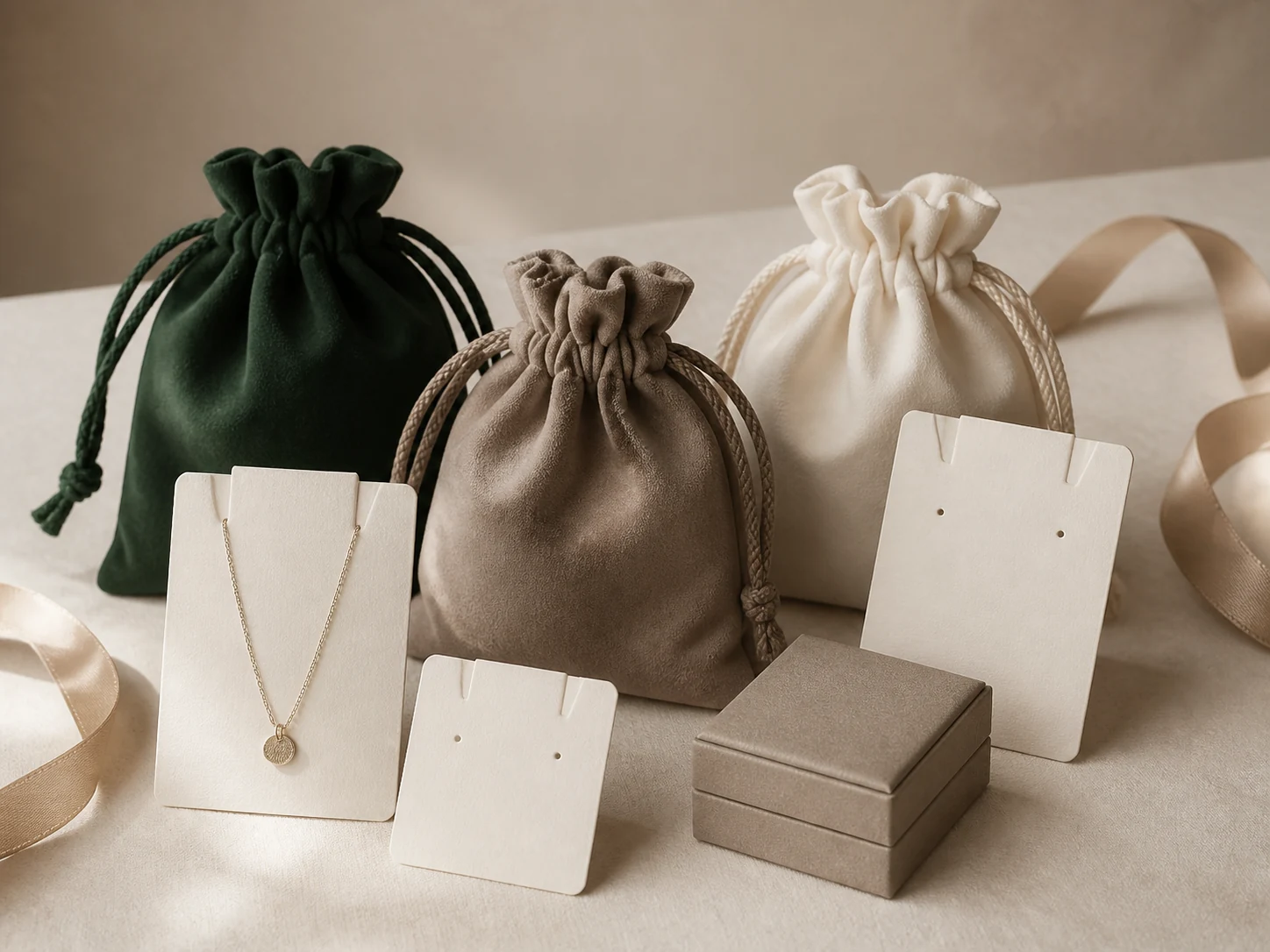
A jewelry box and a jewelry pouch solve different problems. A box gives the piece a defined presentation and space for an insert. A pouch can suit compact retail handover, storage or a coordinated gift set. The useful question is which combination protects the actual jewelry, supports the sales experience and remains practical to pack.
Start with the jewelry, then choose the format
Make a short list of the pieces in the collection. Record their overall dimensions, raised settings, sharp edges, chain lengths and flexible parts. A pendant on a fine chain has different handling needs from a rigid bangle. A pouch that comfortably holds one item may allow two pieces to rub together. A box that looks generous may still have too little usable height once its insert and lining are installed.
Use the largest and smallest relevant pieces in sample reviews. If one packaging size is intended for several products, check every fit condition rather than approving the empty package. Our insert fit and sample approval guide explains how to record a repeatable reference.
Compare the formats against the job
| Decision | Box | Pouch |
|---|---|---|
| Presentation | Can hold a fixed viewing angle with an appropriate insert. | Creates a softer reveal; the jewelry may need a separate card. |
| Movement control | Depends on the insert, clearances and closure. | Depends on fit, lining, compartment design and how the item is placed. |
| Storage and packing | Consider assembled volume, lid handling and insert loading. | Consider opening size, drawstring handling and packing consistency. |
| Branding | Assess artwork on the actual wrap and construction. | Assess artwork on the actual fabric and seam layout. |
| Parcel shipping | Usually requires a separate shipping protection plan. | Usually requires a separate shipping protection plan. |
When a box is worth developing
A box is a useful starting point when the opening moment matters, the piece needs a stable position, or several components should be presented together. For a ring, confirm that the band is held without excessive pressure and that the setting clears the lid. For earrings, account for posts and backs. For a necklace, plan where the pendant sits and how excess chain is restrained.
Choose the closure after checking how staff and customers will use it. A hinged lid, drawer and lift-off lid create different loading and opening sequences. Ask whether the closed box stays aligned during ordinary handling and whether the jewelry can be removed without pulling against delicate parts. Explore jewelry box formats before selecting decorative finishes.
When a pouch is a useful choice
A pouch can be a practical option where flexible storage, a soft hand feel or a compact presentation is part of the brief. Check its usable opening as well as its outside dimensions. The seam, cord channel and lining reduce the space available to insert and remove the jewelry. Test the closure with the intended item inside, not just with an empty pouch.
Evaluate the material against the jewelry surface. Look for visible lint, rough seams, snagging points and color transfer during the agreed handling review. A fabric description alone does not establish suitability for every metal, coating or gemstone. Do not treat a standard pouch as anti-tarnish packaging unless the specific material and claim have been supported by suitable evidence. Review jewelry pouch sizing and closure checklist with the real product sample.
When to use a box and pouch together
A combined set can provide a structured gift presentation plus a separate storage component. It also adds a packing step and another item to specify. Decide whether the pouch contains the jewelry, wraps the box or is placed beside it. Those choices change the required dimensions and the unboxing sequence.
Check the complete combination with any shopping bag, card, ribbon or mailer. Approving each component independently can miss a box that is awkward to remove from its bag or a card that bends inside the pouch. Use a single component list to keep quantities balanced across the packaging set.
Compare quotations using the same assumptions
Ask suppliers to separate the base package, insert or card, branding, individual protection and outer packing. State the quantity for each size and color. A total collection quantity does not show how many units of each construction are required. If a design change reduces one cost but increases packing labor or shipping volume, include both effects in the comparison.
Do not assume a pouch is always cheaper or a box is always more protective. Materials, construction, order mix and the finished packing system determine the result. Use our RFQ checklist to keep supplier responses comparable.
A practical sample decision record
- List the jewelry samples and the packaging versions tested.
- Photograph the loaded presentation and record any movement or contact concerns.
- Have the person who packs orders repeat the loading and removal steps.
- Review the complete retail or parcel combination.
- Record the chosen material, dimensions, artwork version and unresolved changes.
Questions buyers ask
Can one pouch or box size cover an entire collection?
Sometimes, but verify the smallest and largest pieces. If extra space causes movement or the opening makes loading difficult, a second size or a different insert may be more practical.
Does a gift box replace a shipping box?
Do not assume so. Review the complete packed parcel and agree a shipping protection assessment for the intended route. The decorative package is only one part of that system.
What should I send for a recommendation?
Send product dimensions, photographs, quantity by variant, sales channel and intended packing sequence through the custom packaging inquiry form. Include any material or branding references and identify which decisions are still open.