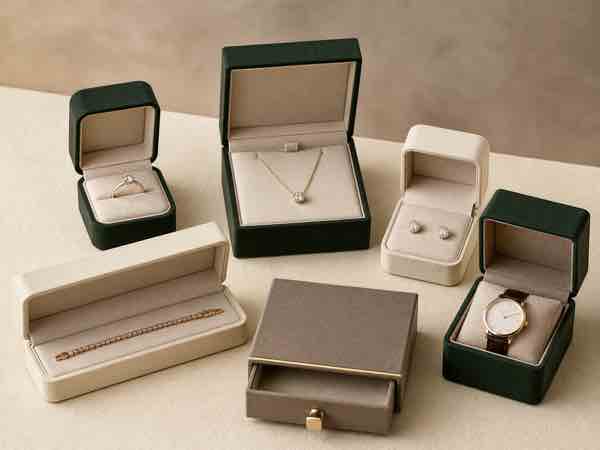
Custom ring, earring, necklace, bracelet and watch boxes developed around your jewelry, branding and presentation goals.
Choose the format around the jewelry
The useful starting point is the product itself: dimensions, delicate areas, how the customer should first see it and how staff will pack it. Those answers determine the internal space and insert before decorative details are selected. A clear specification then connects the structure, surface, color, logo method and outer packing.
Structure
Hinged, drawer, lift-off lid, magnetic and folding formats can be compared by presentation, shipping volume and target positioning.
Material and surface
Rigid paper, velvet, microfiber, leatherette, wood and other confirmed surfaces create different tactile and visual results.
Jewelry fit
A properly planned insert supports the jewelry, protects delicate parts and keeps the item positioned when the box is opened.
Where this packaging works
- Core retail packaging across ring, earring, necklace, bracelet and watch collections
- Gift presentation that needs a rigid structure and controlled opening experience
- Coordinated box families with product-specific inserts and shared brand details
Buyer decision: A single universal box can simplify inventory, but it often compromises product fit. A small family of well-chosen sizes usually creates a stronger presentation while keeping ordering manageable.
Specification points to confirm
| Box format | Hinged, drawer, lift-off lid, magnetic or folding |
|---|---|
| Outer surface | Paper, velvet, microfiber, leatherette, wood or another approved material |
| Logo | Foil, emboss, deboss, print or metal detail according to artwork and surface |
| Insert | Ring slot, earring holes, chain tabs, bracelet cushion or custom configuration |
Supply production-ready vector artwork when available and identify the required logo size and location. For critical colors, provide a physical reference or agreed color standard and review it on the real material. Screens and digital mockups help direction, but they are not production color standards.
Sample approval checklist
- Open and close the box repeatedly and check lid alignment
- Install the actual jewelry and test removal without snagging
- Compare color, logo position and insert covering under normal retail lighting
Review the sample in the same way the packaging will be used. Open it, install and remove the jewelry, handle the closure, compare the branding and place it inside any pouch, bag or shipping protection included in the final system. Record approved dimensions, material, color, logo, insert and packing details rather than relying on photographs alone.
Planning a bulk order and future reorders
Share the target quantity by size, destination country and required timing early enough to compare suitable constructions. Individual packing, carton quantity and shipment protection can affect both delivered condition and shipping volume. For repeat orders, refer to the approved sample and written specification, and review any proposed material or process change before production.
Questions buyers ask
Should every jewelry type use the same box size?
Not necessarily. Shared materials and branding can create consistency while the dimensions and insert remain appropriate for each piece.
Can the color, material, logo and insert be customized?
Yes. The workable combination is confirmed through the brief, material review and sample rather than assumed from a digital image.
What should be included in the RFQ?
Send the jewelry type and dimensions, target quantity, preferred structure or reference, material and color direction, logo artwork, destination and required timing.