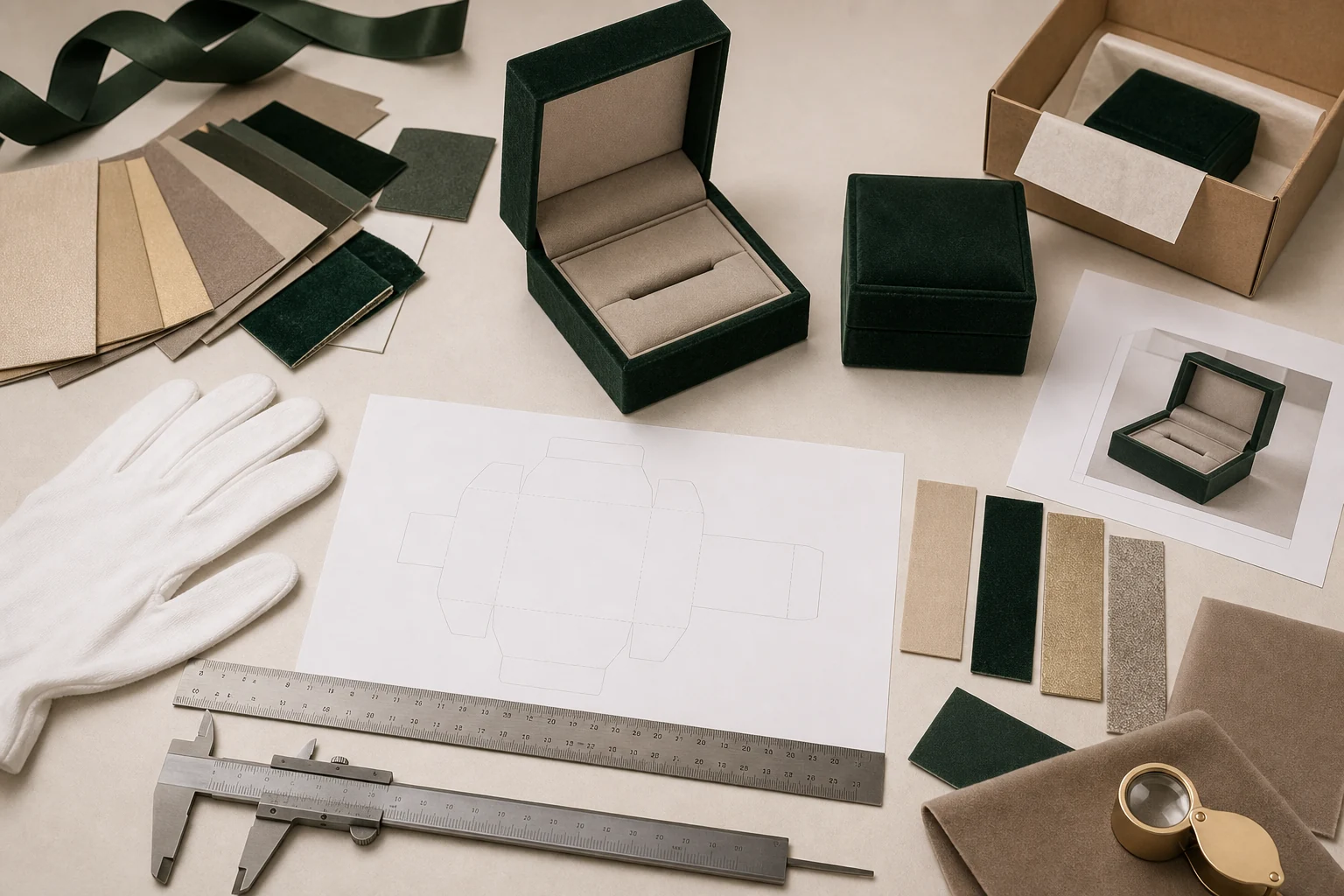
A useful jewelry packaging RFQ describes what must be supplied, how the result will be approved and which costs belong in the quotation. A reference photograph helps communicate appearance, but it rarely defines the insert, usable dimensions, finish layers or export packing. Use this checklist to reduce assumptions before comparing suppliers.
1. Identify the product and packaging components
List the jewelry types and the packaging parts required for each one. A ring box with an insert, pouch and shopping bag contains four separate components. Give each component a reference name or code so that drawings, samples and quotations use the same vocabulary. State whether components will arrive together, be packed as complete sets or be assembled by your team.
Share photographs of the actual jewelry and provide measurements in one consistent unit. Distinguish external box dimensions from usable internal space. Include raised stones, clasps, earring backs and other projections. If dimensions are provisional, identify them as provisional and explain when a physical sample will be available.
2. Break down quantity by variant
A combined quantity can hide several small production batches. Show how many units are required for each size, color, material and logo version. Separate the first order from any forecast for future purchases. A forecast helps planning, but it should not be presented as a committed order.
| RFQ field | What to provide | Why it matters |
|---|---|---|
| Component reference | Unique code for each box, pouch, card or bag | Connects quotes to the correct item. |
| Product fit | Jewelry dimensions and sample availability | Defines usable space and insert development. |
| Order mix | Quantity per size, color and artwork version | Reveals the actual production batches. |
| Material and finish | Preferred surface, color reference and logo method | Reduces substitutions hidden inside a price. |
| Approval | Sample scope and named decision maker | Clarifies what must be accepted before production. |
| Packing and destination | Unit protection, carton needs and delivery location | Allows the delivery basis to be described clearly. |
3. Describe material and construction separately
Terms such as luxury, premium or eco-friendly do not define a build. Identify the structural direction, outer surface, lining and insert as separate decisions. State whether the reference is mandatory or only a starting point. If you welcome alternatives, ask suppliers to show the proposed changes alongside the base quotation.
For a paper-wrapped box, for example, the wrap appearance and the underlying construction both need review. For a pouch, specify the desired feel and functional checks without assuming that a fabric name establishes performance. Our materials and finishes page and box versus pouch comparison can help structure the discussion.
4. Provide artwork that can be quoted
Include the logo, approximate size and position, preferred process and number of artwork versions. State where different surfaces carry different marks. A logo on the lid, a printed insert and a branded shopping bag are separate production requirements.
Where final files are unavailable, provide a clear preview and mark it as a quotation reference. Confirm which production-ready files will be needed before sampling. Use a physical color reference when appearance is critical, and review the finish on the actual material. The artwork handoff guide covers version control and approval records.
5. Make sample scope and timing explicit
Ask what the proposed sample represents: structure only, material and color direction, or a fully branded production reference. Record any differences from the intended bulk construction. A sample with substitute material may help evaluate dimensions, but it should not silently become the reference for surface appearance.
State the desired in-hand date and destination. Ask the supplier to distinguish development, sample review, production and shipping assumptions. Clarify which stage starts only after artwork, samples or commercial terms are accepted. Avoid treating an early estimate as a confirmed delivery commitment.
6. Separate price components and exclusions
Request a clear description of what the quoted unit price includes. Ask about sample charges, artwork or tooling work, inserts, individual wrapping, labels, cartons and shipping where applicable. Identify the currency, validity period and delivery basis in the written quotation. Compare the same scope across suppliers before deciding that one price is lower.
When an alternative is proposed, record exactly what changes: material, thickness, dimensions, printing method, packing method or quantity. The purpose is to understand the trade-off, not to choose a package by its unit price alone. For multiple repeat items, see wholesale packaging planning.
7. Define acceptance and reorder information
Agree the attributes that will be checked: construction, appearance, logo position, jewelry fit and packing arrangement. Keep the approved sample reference, drawing version and written change list together. If a material or process changes during a reorder, review whether a new sample is needed rather than relying only on a previous order number.
The quality control checklist provides discussion points. Actual acceptance criteria and any testing requirements should be agreed for the project before production.
Copy this inquiry outline
- Project and destination:
- Jewelry types, dimensions and sample availability:
- Packaging components and quantity by variant:
- Preferred construction, material and color references:
- Logo files, finish, size and placement:
- Insert, lining and individual protection:
- Sample scope and approval contact:
- Required delivery timing and packing details:
- Alternative constructions welcome:
- Information still to be confirmed:
Send the completed outline through Request a Custom Quote. Clearly marked unknowns are more useful than guessed dimensions or an assumed material specification.
Questions buyers ask
Can I request a quote before the design is final?
Yes. Separate confirmed requirements from preferences and open decisions. Ask for the assumptions behind any provisional price so you can update the comparison after sampling.
Should every supplier receive the same brief?
Use the same base brief and version number. Keep alternative proposals in a separate line so differences remain visible when comparing prices and sample plans.