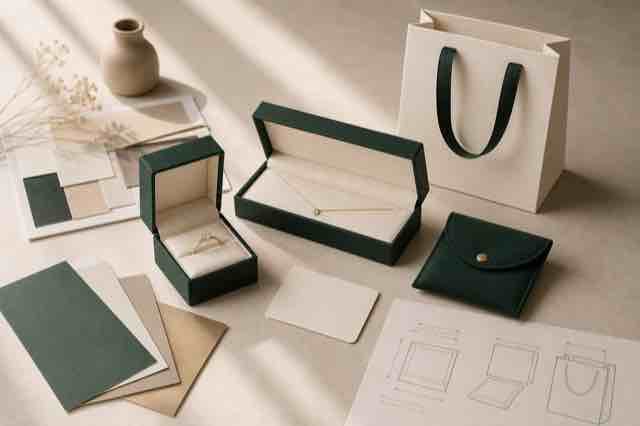
A new brand does not need every packaging format on day one. It needs a clear core presentation that fits the jewelry, budget, launch timing and likely reorder pattern.
Plan the outcome before choosing details
Custom packaging decisions are easier to compare when the intended result is explicit: what the packaging must hold, where it will be used, how it should feel at the target price position and which details must remain consistent in bulk production. This turns visual references into a practical development brief.
Start with core products
Choose the box or pouch sizes that cover the largest share of the launch collection.
Build one visual system
Use shared colors, materials and logo rules across the first components.
Protect future expansion
Document approved specifications so new sizes and bags can be added coherently.
Prepare the brief
Send jewelry dimensions, quantities, timing, artwork and visual references.
Sample what matters
Use the actual jewelry to confirm fit, opening experience, color and branding.
Evaluation note: Begin with the formats that cover most of the launch assortment. A focused core range protects budget and timing while leaving clear rules for later expansion.
Information that improves development accuracy
- Launch assortment and jewelry dimensions
- Priority box and pouch sizes
- Brand guidelines or mood references
- Realistic quantity by component
- Launch date, destination and approval schedule
A useful brief does not need every technical answer. It should explain the jewelry, target customer experience, quantity, destination and commercial constraints. Suitable structures and processes can then be compared, with important assumptions made visible before sample development.
What to approve on the sample
Appearance
Review color, surface, proportion, logo size and visible workmanship under normal use conditions.
Function
Install the actual jewelry, test opening and closing, and check protection, clearance and removal.
Production reference
Record dimensions, materials, finish, insert, accessories and packing requirements for bulk checks and reorders.
Connect development to the commercial order
Confirm the quantity by component, destination and required timing before finalizing the route. Structure, material use, finish complexity, individual protection and carton configuration can affect cost and shipping volume. For a multi-item program, align quantities and approval timing across components so boxes, pouches, cards and bags do not create mismatched inventory.
Questions to resolve before production
Can a digital mockup replace a physical sample?
A mockup is useful for direction, but a physical sample is the better reference for structure, touch, color, logo execution and jewelry fit.
How are changes after sampling handled?
Identify the exact changed detail and review its effect on cost, timing, construction and other components before approving a revised specification.
What helps repeat orders stay consistent?
Retain the approved sample and written specification, then review any proposed substrate, color, component or process change before a new run.